Agent Review Console · live
Keep a human in the loop.
Agents earn autonomy one skill at a time, and the work that should never run alone keeps its human gate for good.
- BizOps
- RevOps
01
The human checkpoint is disappearing.
In six months the share of companies requiring a sign-off before a high-risk AI action fell by more than a third, and the share letting agents act alone more than doubled (JumpCloud IT Trends Report, 2026). I run agent workflows every day, and what keeps them useful is a checkpoint cheap enough that nobody skips it.
02
Autonomy is earned, one yes at a time.
Every action an agent wants to take starts as a request waiting on a person. Approve the same kind of task cleanly enough times and the console offers to run it on autopilot, under a written rule with its caps and an undo.
03
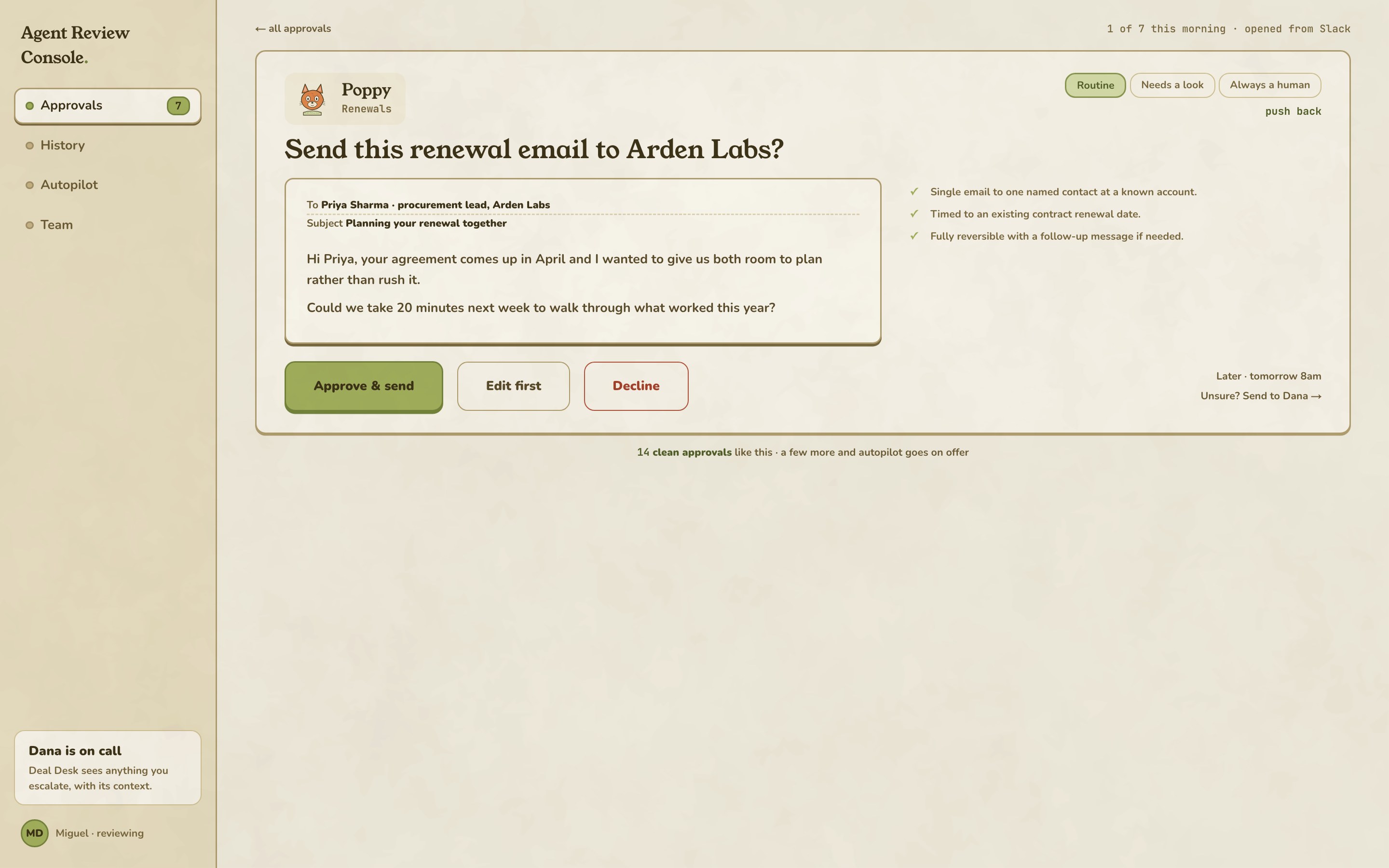
A plain question, with the thing itself in view.
Each request shows what it does, what it touches, whether it reverses, and a live risk grade. The email you approve is shown the way its recipient will see it.
 open full size ↗
04
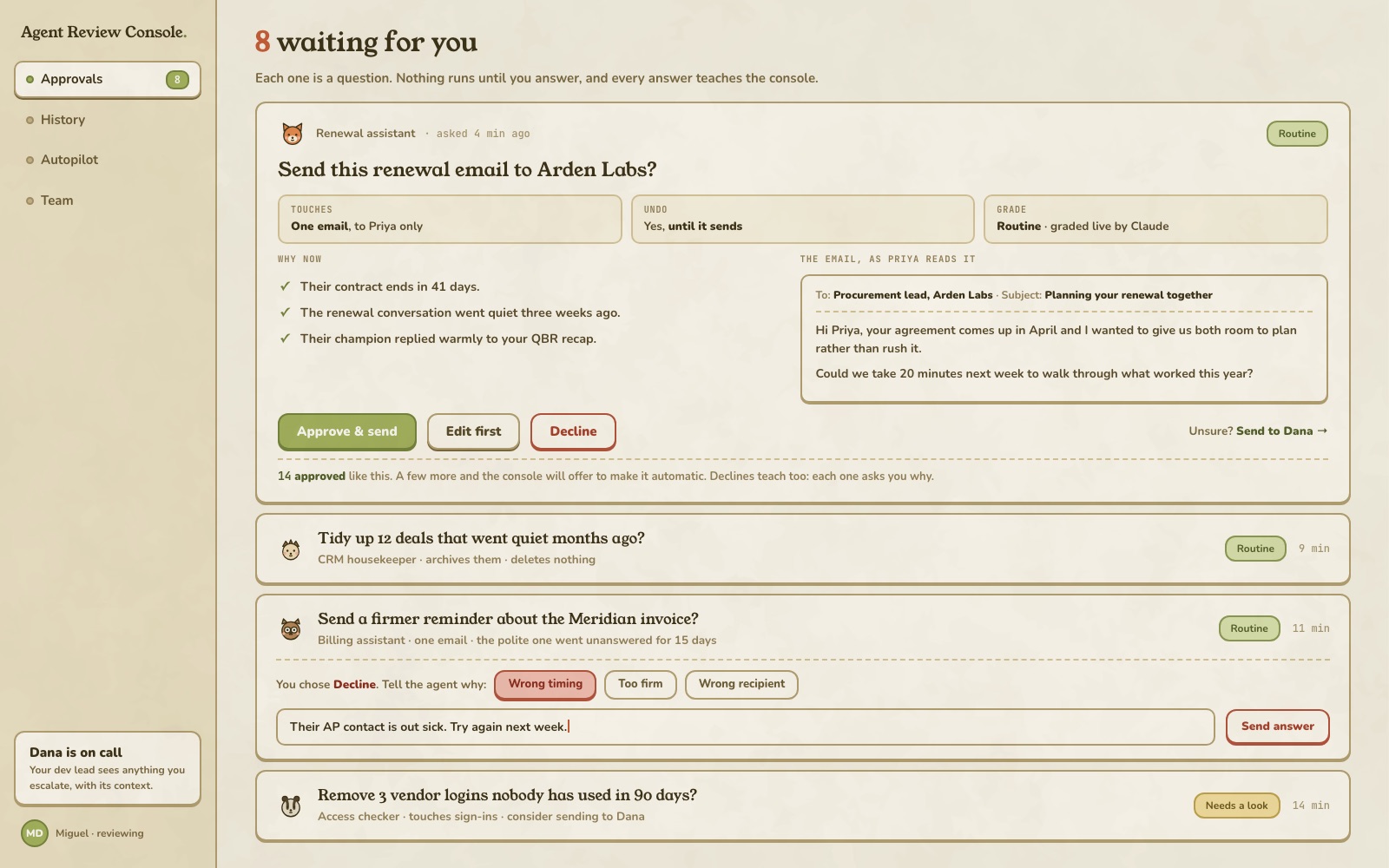
The first decide screen was a dashboard.
Eight requests, a queue, four tabs of nav, and the first thing it asked for was triage. One question at a time replaced it, and the queue retired to the demo.
 open full size ↗open full size ↗
05
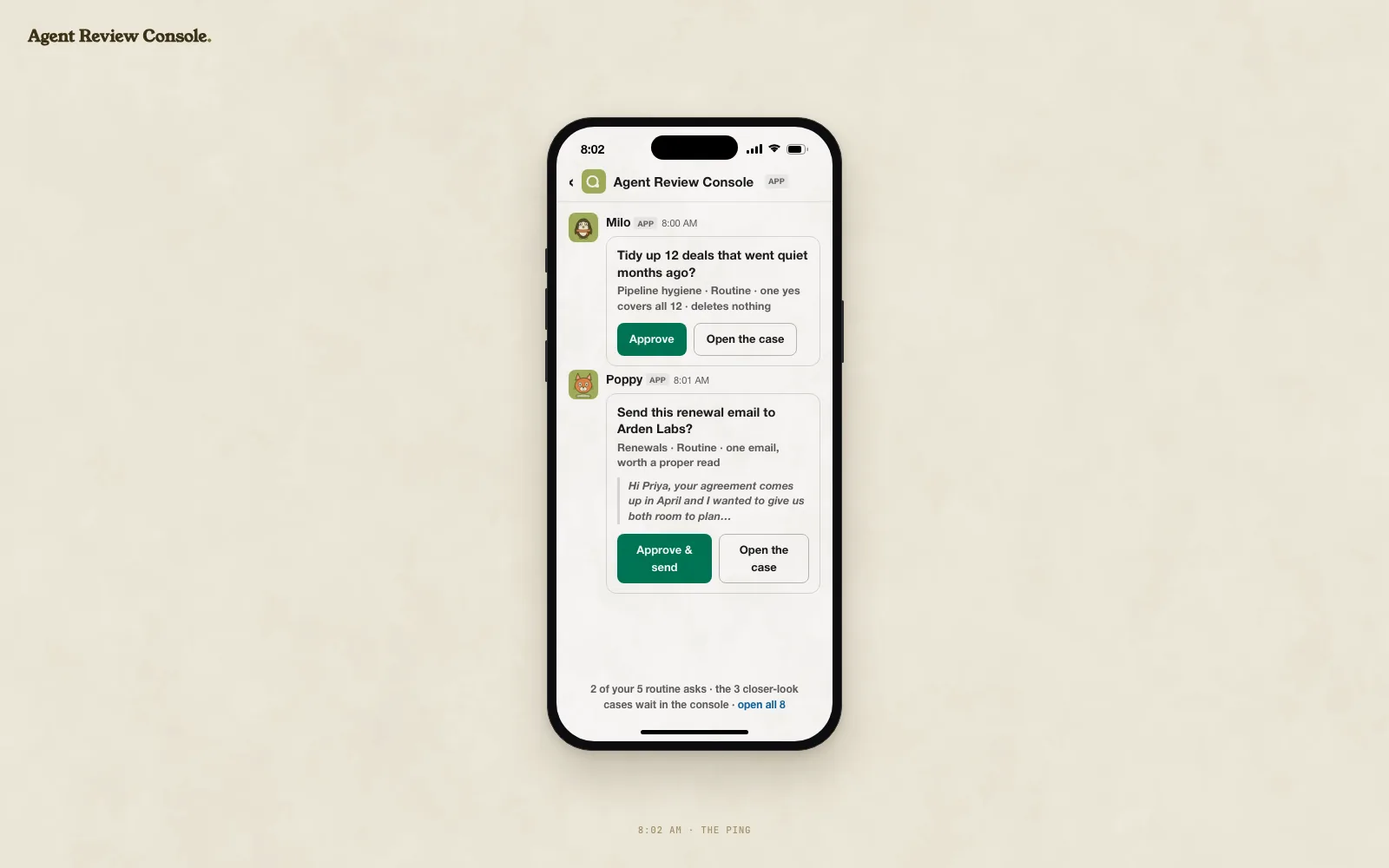
The routine yes fits your pocket.
Requests land in Slack, and a routine approval is one tap from your phone. Every yes carries a short undo.
 open full size ↗
06
Some work never graduates.
Anything that commits money, sends at scale, or posts in public keeps a person on it for good. The inbox shrinks where that stays safe and holds where it should.
07
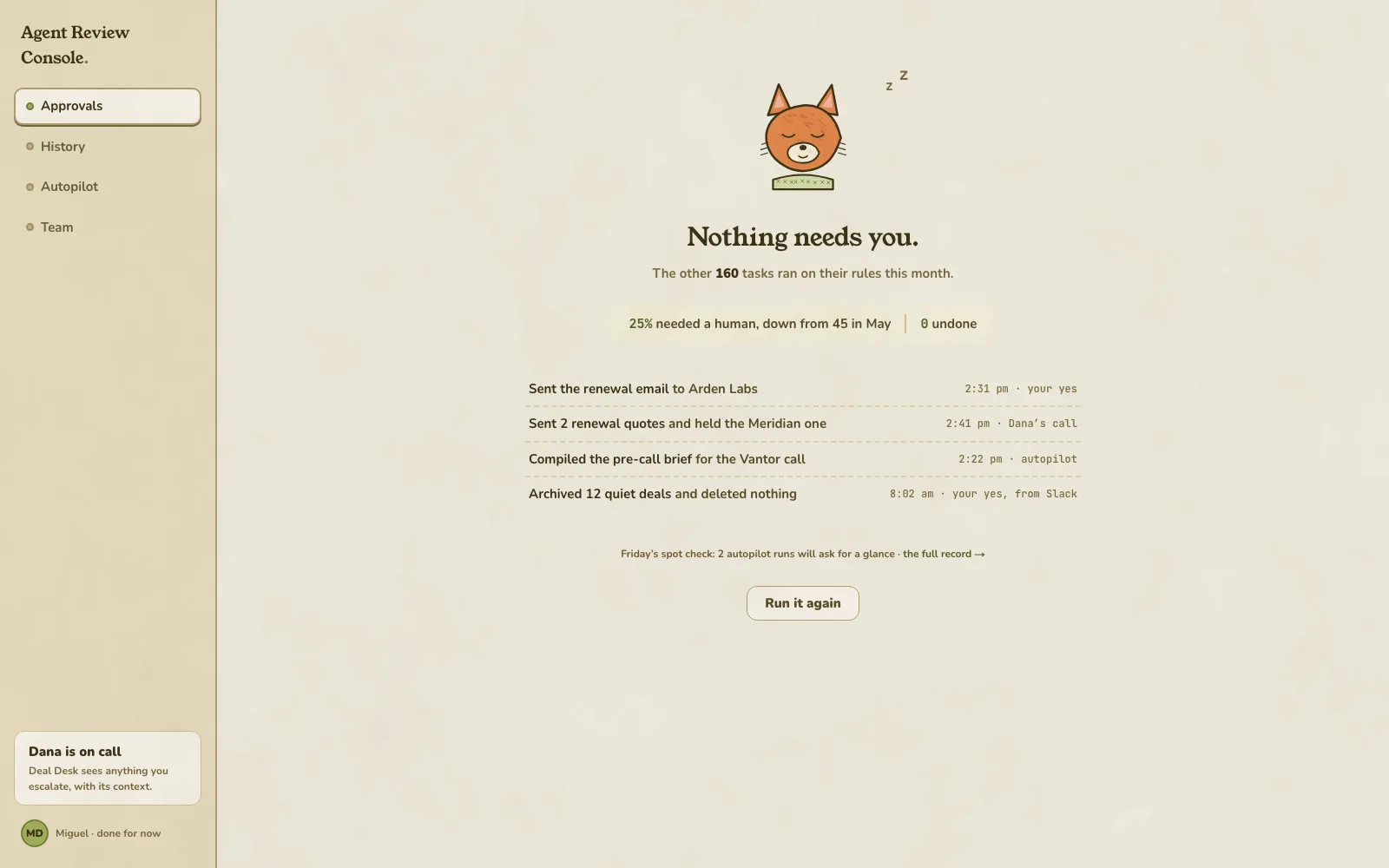
The product succeeds by shrinking.
The record pairs the falling share of tasks needing a human with the count of actions undone, still zero. This is the inbox at zero, from the live demo.
 open full size ↗
verified
- ✓Edits and declines teach the console as much as approvals do, and a decline always asks why.
- ✓Autopilot is earned by clean runs, kept honest by weekly spot checks, and one bad run sends a rule back to asking.
- ✓Trust is scoped per skill, never per agent, so a rule graduates one capability at a time and the blast radius stays knowable.
- ✓Escalating takes one click, and the case arrives with the context already attached. Guidance sent back can become a standing rule.
- ✓Risk grading runs live through the Anthropic API, and you can push back on a grade.
scope
- →No bulk approve, on purpose. The cure for a crowded inbox is graduation and batching by task, never a select-all.
- →One team, one gate in the first version. The gate can move to a named delegate; multi-team and multi-approver come later.
- →The agent roster is fixed in v1. Describe-a-job hiring waits until the core loop proves itself.
- →Connections stay simple at first: one system in, one system out. Deeper integrations come once the core loop has proven itself.
how i built it
- ▪I built this with Claude Code. The product calls are the ones worth defending: what earns autonomy, and what never gets it.
- ▪The risk grade on each request is generated live, and a quiet fallback means a slow call never leaves someone stuck in the demo.
- ▪Forty-three checks run before this ships, from the arithmetic inside the fiction to whether a key could leak.