B-02 · live build
Kickoff
Send each client stakeholder a five-minute gut check, and eight agents turn where they disagree into a kickoff pack the room can argue with.
- Creative Ops
- Strategy
01 why I built it
The homework doc was always the same. Twenty questions on a shared form, sent to the client, chased for three weeks. By the time it came back, five people had quietly negotiated it into one tidy answer, and the thing I actually needed was gone. One of them had said heritage. Another had said reinvention. Somewhere in the merge they split the difference into something nobody in the room believed, and we would build a rebrand on top of it. I ran that process enough times to stop trusting the tidy version. The disagreement was never noise. It was the brief, and the process was built to sand it off. So I rebuilt the homework for a world with agents in it. The machine takes the half you can research. Each person answers the half only they can, alone, before anyone rounds off their edges. The divergence comes back intact, mapped, and ready to fight over.
02 the system built
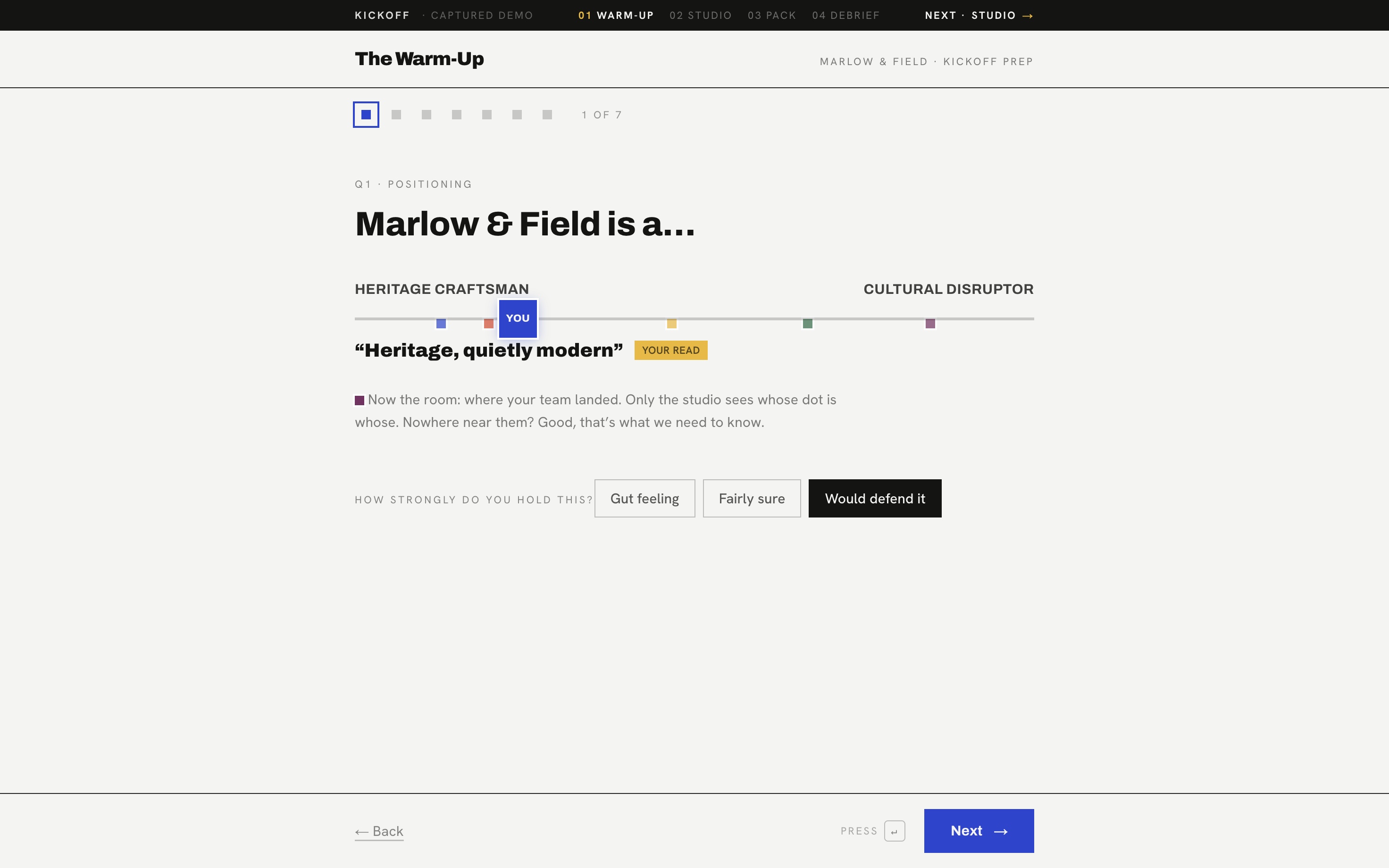
Each stakeholder gets the Warm-Up on their own. Five minutes of gut calls on dials, card sorts, and one honest box their colleagues never see. Nothing gets averaged. The studio picks the register for each client, anywhere from buttoned-up to bold, and watches the room come in one person at a time.
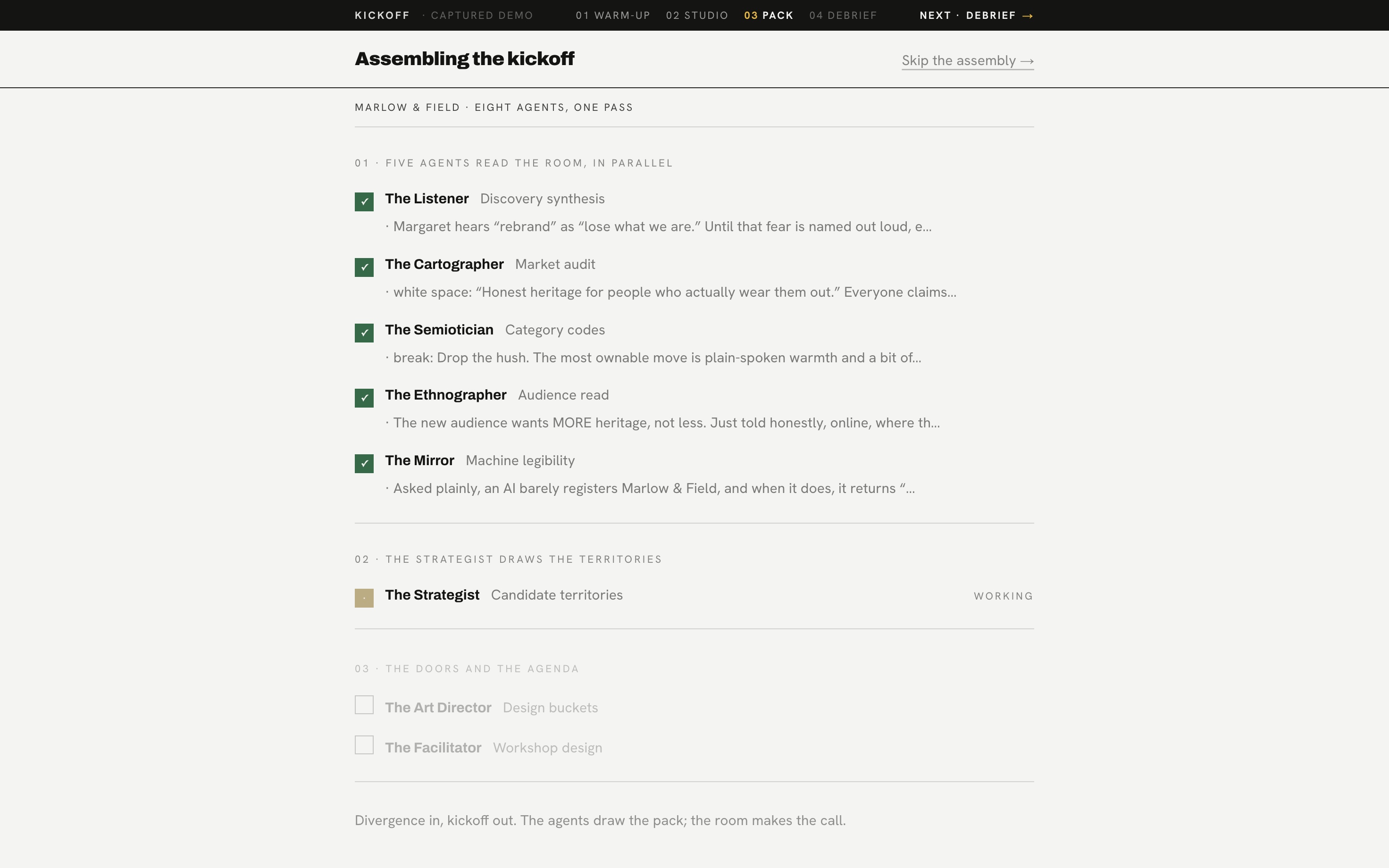
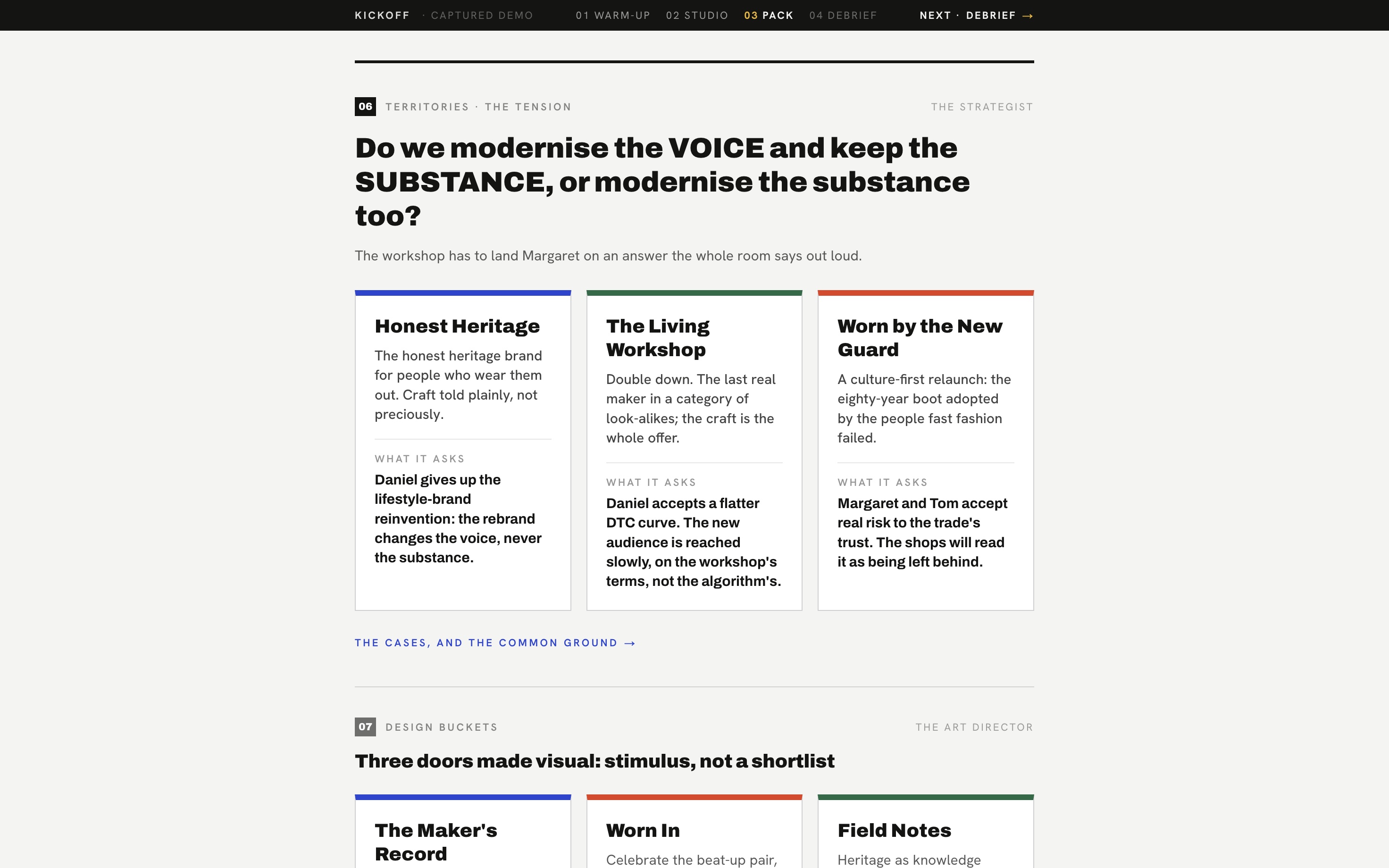
Then eight agents read the whole room in a single pass. Five of them fan out at once, over the divergence, the market, the codes the category leans on, the audience, and what an AI says the brand is when you ask it cold. A strategist takes all five reads and draws two or three candidate territories, each with the cost of choosing it named out loud, and then stops. No verdict. An art director turns the territories into visual doors, and a facilitator builds the workshop that makes the room choose. The findings lead. The working sits one fold underneath, for whoever wants to check it.
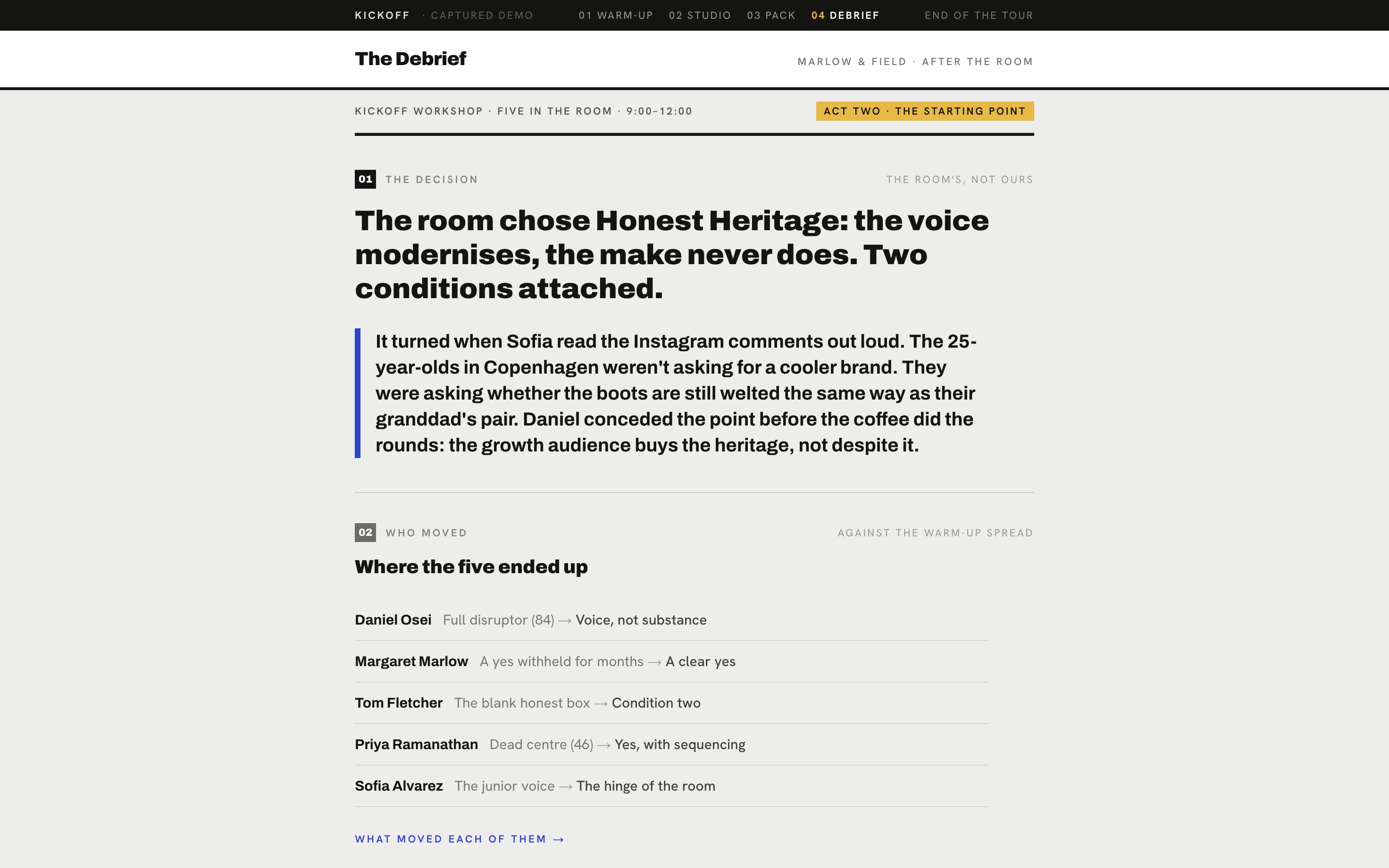
The room decides at the kickoff, not the tool. Afterward the Debrief records who moved, what died in the discussion, and the direction the room committed to, then hands the studio its first moves. It is the start of the strategy phase, not a bow tied on the end of one. What it saves is the week a producer and a designer would otherwise spend synthesizing all of this by hand. It never pretends to do the thinking that comes next.
stack Next.js · Tailwind · eight-agent pipeline · captured runs, no key in production
03 proof
 open full size ↗
 open full size ↗
 open full size ↗
 open full size ↗
04 verified / scope
verified
- ✓Eight agents run in one pass, from the divergence read through the market, the category codes, the audience, the machine mirror, the territories, the visual doors, and the workshop agenda.
- ✓Four fabricated engagements across the archetype spectrum, each with a five-person committee and a full pack.
- ✓Three tone registers reskin the client's questions per engagement.
- ✓Answers stay per-person, and the honest box goes to the studio, never to colleagues.
- ✓The strategist proposes territories with their costs and never a resolved position, so the room makes the call.
- ✓No login, no key, nothing to set up, because production ships captured runs only.
scope
- →The demo runs on captured output by design, and the live engine ships in the repo as proof rather than wired to a public server.
- →One engagement carries the Brief and the post-workshop Debrief so far, and the others end at the pack.